A BRIEF HISTORY OF THE LONDON DOCKLANDS

Prior to the 19th Century, London didn’t have purpose-built docks.  Going back to the Romans through the Medieval Period, ships docked in small quays near the City of London and Southwark that was known as the Pool of London.  As it was, the Pool of London offered little protection against the elements or thieves and the space was pretty cramped.  However, this didn’t stop London from becoming a prosperous port as its wealth increased from the Romans to the Saxons and then the Normans.  Embankment of the River Thames occurred from the 12th to 14th Centuries that added 42 square miles of useable land around Rotherhithe, Deptford, and the Isle of Dogs.

It wasn’t until the reign of Queen Elizabeth I and then King James I that London actually did something to improve the ports along the nine miles that make up the London Docklands.  The first act was to establish “legal quays” on the north bank between London Bridge and the Tower of London.   However, the quays soon became overcrowded and in 1663, Parliament allowed for “sufferance wharfs” on both banks to alleviate the congestion.  Despite this, London’s popularity as a port continued to grow at an almost exponential rate, with activity doubling between 1700 and 1770 and ships vying for space in ports that could only hold about 1/4 of them.  This meant ships sometimes waited days or weeks to unload their cargo.

In the 1790s, William Vaughn began to circulate a number of pamphlets called “Reasons in Favor of the London Docks” that advocated the government to solve the maritime gridlock along the river.  Parliament finally took action in 1800 when it passed a bill that proposed new docks.  The first dedicated docks were built on the northern end of the Isle of Dogs in Rotherhithe in 1802 known as the West India Dock.  The West India Dock encompassed 90 acres and cost roughly £82 million in modern currency.  Such was the success of the West India Dock that others soon followed for the remainder of the century including the East India Docks, St. Katherine Dock, Royal Victoria, Millwall, Surrey, Royal Albert, and the London Docks, amongst others.  The London Docks alone could handle 500 ships and the warehouses could store 200,000 tons of goods.

The Port of London Authority (PLA) came into existence in 1909 and the last set of docks added was the King George V Docks in 1921.  Moving further into the 20thCentury, the Docklands were a focal point for the London Blitz, and the German Luftwaffe dropped some 2,500 bombs on the area.  Post-war rebuilding led to a resurgence of the docks in the 1950s, but it wasn’t to last.  By the 1960s, many shipping companies had adopted the new container system which increased the size of vessels beyond what London’s docks could handle.  The area experienced a rapid decline until they were ultimately closed in 1980.

Yet, even before the last of the docks closed, London was already making plans to redevelop the Docklands.  The Greater London Council and Parliament formed the Docklands Joint Committee, which produced a strategic plan for development in 1976.  It mapped out development in four phases to take place from 1982 to 1997.  In the first phase, new district centers, housing, and industrial areas would be constructed.  Phase two would expand housing in Wapping, Beckton, and the Isle of Dogs.  Phase three proposed an increase of public green space.  Phase four would have wrapped everything up and connected all the development together.

In the end, the Docklands Joint Committee’s proposals were not implemented as Thatcher’s government preferred for private industry to take the lead in redevelopment rather than using public funds.  Instead, Secretary of State for the Environment Michael Heseltine formed the London Dockland Development Corporation in 1981.  The government also created an enterprise zone where developers were exempt from property taxes and were granted other allowances and economic incentives.  Critics claimed that this did more to encourage luxury flats and amenities rather than affordable housing.  Ultimately, the LDDC’s goals were successful as the Docklands transformed into a mixed-use area filled with housing, restaurants, shops, offices, and industries.

Amongst the most successful of the new developments was Canary Wharf, dominated by the 45-story skyscraper One Canada Square.  Rail and London Underground lines were extended out to Canary Wharf in the 1990s.  By 2003, Canary Wharf’s population numbered over 50,000.  It has become emblematic of the success of the development scheme overall and a sign that even the most devastated areas can find a second life.

How London Became Addicted To Coffee

At a time when a brief  ‘thanks’ is the limit of conversation between strangers in cafes, it’s hard to imagine that London’s coffee houses were once considered the height of civility. But when coffee first arrived in London — in a much more bitter, vulgar form that our modern-day caramel lattes — it was the drink of the intellectuals.

Coffee’s arrival in London

The advent of coffee in the capital is harder to trace than that of tea, although we do know that coffee arrived earlier, as result of travel to the Ottoman Empire. The Levant Trading Company, and later the British and Dutch East India companies, were among early importers of coffee to England. When it arrived, coffee would be stored in warehouses such as those in Shad Thames and at Hay’s Galleria.

The first coffee was a very basic drink, made well in advance and reheated when served. This was long before the days of filtering, and the niceties of milk and sugar weren’t added until much later. It wasn’t much enjoyed by people at the time, who drank it for its stimulant qualities rather than its taste. Advert and posters of questionable scientific basis were published by proprietors of early coffee houses to get people hooked on the drink — the one pictured above can be seen in the British Museum.

London’s first coffee houses

The iconic lantern of Cornhill’s Jamaica Wine House screams ‘history’. But the eponymous grape juice is a mere descendant of the site’s beverage history. The modern-day watering hole sits on the site of London’s first coffee house — a rather grand description for what was effectively a shed serving up a bitter liquid.

As a blue plaque informs 21st century passers-by, Pasqua Rosee opened a coffee house in 1652. Although the premises bore Rosee’s name and picture, a Daniel Edwards was the driving force behind it. A member of the Levant Company and a Turkish goods trader, Edwards employed Rosee as a servant. It’s thought that Edwards’ visitors enjoyed coffee so much, he employed Rosee to sell it to the public, although an alternative story is that the two had a falling out and Rosee set up the business alone, having been introduced to coffee by Edwards. Either way, it was a popular venture, reportedly selling 600 servings of coffee every day. Samuel Pepys mentions a visit in his diary in December 1660 — a big year for Pepys, as he also discovered tea.

Over to the west Oxford was ahead of the game. The scholarly city was home to ‘penny universities’ (named for the penny entry fee and academic conversation of coffee houses) before London got its first whiff of a coffee shop. In fact, it may be due to their success in Oxford that they came to London at all. Pasqua Rosee opened a coffee house in Oxford in 1651 before bringing it to London a year later — and his wasn’t the only coffee house operating in Oxford at the time.

Coffee houses were civilised. Women were banned (although some had female staff members), and male writers, politicians, journalists, poets and other members of the educated classes would gather there to discuss the issues of the day. Different venues had different focuses — political chat was much more rife in the coffee houses of Westminster, while theatrical reviews were offered freely by patrons in the West End.

Tavern owners saw Rosee’s enterprise as something of a threat to their custom, but that didn’t stop coffee’s rise in popularity, with several other coffee houses popping up in subsequent years. Rosee himself apparently had plans to open a second branch nearby — London’s first mini-chain, perhaps? — but they never came to fruition.

Interestingly, London’s first tea was sold in a coffee house, operating out of Exchange Alley in the City around 1657-58. 

Button’s Coffee House, Russell Street

This Starbucks occupies the site where Button’s Coffee House is thought to have been

Other establishments of note included Button’s Coffee House, which opened in Covent Garden’s Russell Street in 1712 and functioned as the unofficial offices of a newspaper named the Guardian (nothing to do with the modern newspaper). So persistent was the presence of Guardian writers in Button’s, that a letterbox in the shape of a lion’s head was installed on the exterior of the building, for the public to submit news for publication. Alas, the newspaper lasted barely seven months, but the lion can still be seen at Woburn Abbey today.

Lloyd’s Coffee House

Inside the modern Lloyd’s of London building (not on the same site as the coffee house)

Modern insurance market Lloyd’s of London — famous for its Lutine Bell — exists today thanks to a 17th-18th century business called Lloyd’s Coffee House. A popular meeting place for sailors, merchants and shipowners, relationships forged here led to the establishment of Lloyd’s of London, and several other businesses of seafaring matters.

Tom King’s Coffee House, Covent Garden

An oil on canvas version of Hogarth’s Morning

Not all early coffee houses were high-brow. Tom King’s Coffee House — later known as Moll King’s Coffee House — was located in Covent Garden in mid-18th century and was a venue of ill repute. Its opening hours ran from the time the local taverns shut, until dawn. Coffee was reportedly an afterthought, with alcohol being served, and the business functioning primarily as a brothel, of sorts. To satisfy a legal loophole, there were no beds on the premises, bar the Kings’ own. Instead, introductions between prostitutes and customers were made on the premises, before they were taken elsewhere to get down to business. King’s Coffee House features in Hogarth’s Morning, showing two men pawing at girls in Covent Garden Piazza in the early hours.

Bar Italia, Soho

Soho’s Bar Italia is not one of London’s earliest coffee shops by any stretch, but its 1949 birth date makes it London’s longest running coffee shop, serving the likes of Jimi Hendrix and the Rolling Stones in its time. Its impressive tenure is nonetheless obliterated by Oxford’s Queen’s Lane Coffee House, which has been operating continuously since 1654.  

For making your own coffee at home, hit up nearby Algerian Coffee Stores, which has been around since 1887, specialising in tea and coffee blends, plus the equipment you need for brewing your own.

Coffee houses under threat

Traditional taverns and ale houses weren’t the only ones threatened by these new-fangled coffee houses. King Charles II banned the establishments in 1675. The official line was that they disturbed the peace and promoted idleness, but the King was no doubt fearful that they provided the ideal environment for rebellious meetings and the plotting of treason.

Unfortunately for the king, several of his minsters were coffee lovers and opposed the ban. It was abolished before it even took effect, and London’s caffeine takeover continued apace.

Arrival of the coffee giants

Whatever your opinion of the quality of their coffee, there’s no denying that chain coffee shops have taken over London. But when did these modern-day incarnations emerge?

The capital’s first Starbucks opened on Chelsea’s Kings Road in 1998, a BBC report at the time stating that it «intended to be the first of 500 stores in Europe.» 20 years later, London alone often feels like it’s close to that number. You can still grab a latte at that early settler, at 123 King’s Road. Until recently, standing on a specific spot on Villiers Street near Embankment allowed you to see three branches of the chain. One’s now closed, rendering it one of several places in the capital where two Starbucks are visible.

London’s first Starbucks

Pret a Manger predates Starbucks, opening its first branch in Hampstead in 1983, although as its name suggests, the focus was more on the food than the takeaway coffee. Despite its Italian-sounding moniker, Costa was established here in London, beginning as a coffee roastery in 1971 before opening its own store in Vauxhall Bridge Road in 1978.

Coffee ghost signs

The Albion Coffee House’ can just about be made out

Ghosts of the London coffee industry can still be seen around town — and we’re not just talking about a boarded-up Costa. Squint up at the house by bus stop KC on Kennington Lane (pictured above) for a nod to the building’s history as Albion Coffee House, apparently a regular haunt of Charlie Chaplin’s father.

Harder to spot is an old advertisement for ‘The Royal Coffee & Dining Rooms’, located on Holloway Road, overlooking St Mary Magdalene Garden.

‘James Ashby & Sons Ltd Embassy Tea & Coffee’ can be made out on the side of 195-205 Union Street in Southwark. Although the building was under threat in 2008, it’s still standing — and the sign still mostly visible — today. 

Keep your eyes peeled in the vicinity of Tooley Street and Hay’s Galleria for old signposts to the Bramah Tea and Coffee Museum. Alas, the museum closed in 2008 following the death of its founder, Edward Bramah, but for a few years it was a fascinating snapshot of the history of the tea and coffee trades in the capital.

Coffee meets booze in a match made in heaven

Coffee in our cocktails is something we’ve long been accustomed to thanks to the Espresso Martini, which itself was invented here in London. The story goes, legendary bartender Dick Bradsell whipped up the vodka and coffee blend while working at Soho Brasserie, as a response to a young woman’s request for a drink that would «wake her up and fuck her up».

Coffee’s infiltrated other drinks too. Greenwich-based Meantime Brewery launched a ‘Beerista’ range in 2017, including a coffee porter.

Coffee roasteries in London today

The Coffee Bar at Harrods

Today, coffee’s not only served in London, the beans are roasted here too. Caffè Nero prepares its special coffee blend in its Battersea-based Roastery, before shipping it to branches all over London and beyond to go into your morning latte.

The coffee sold in cafes at Tate art galleries is produced inside a second world war bunker in the grounds of Tate Britain. It roasts a whopping 22,000 kilos of coffee every year.

Both of these are off-limits to the public, but if you want to watch your coffee being freshly roasted before it’s served, head to The Roastery and Bake Hall in Harrods, where beans are prepared in house, allowing Harrods control over the quality. Sit back at the marble bar counter in the art deco hall and listen out for the bell, which rings every 15 minutes to announce that freshly-baked bread is ready.

16 Warning Signs You Only See In London

A celebration of  ‘thou shalt nots’ peculiar to London.

1. Do not fall off lions

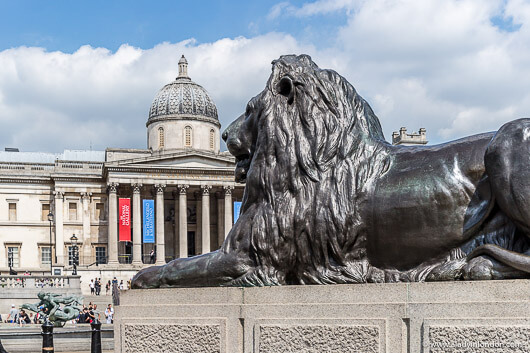
If we’re interpreting this Trafalgar Square sign correctly, it’s OK to clamber on the lions, but refrain from plummeting.

2. Do not feed the flying rats

While we’re in the area, here’s another forbidden activity. Pigeon feeding was banned in 2003 by Mayor Ken Livingstone.

3. Do not touch the pelican

It’s easy to run up a massive bill in London, but you should never touch one. At least not according to this sign in St James’s Park, where a colony of pelicans has presided since the time of Charles II.

4. Do not touch the walrus

The Horniman Museum in Forest Hill is famed for its mal-stuffed walrus. Equally instagrammed is the sign telling you not to touch it.

5. Warning: tigers think you’re steak

London Zoo’s tigers have some pretty serious cataract problems, judging by this typeface-juggling notice.

6. Warning: micro-chipped fish

Thamesmead is often labelled as dystopian. This sign does nothing to combat the stereotype.

7. London’s aquatic answer to the Berlin Wall

The Thames Barrier is presaged by this mighty warning sign. Someone needs to paint a ‘NOT YOU, PEDESTRIANS’ on the bottom.

8. Danger: Olympic Park

Shocking juxtaposition of signs at the Queen Elizabeth Olympic Park.

9. Shite escalator warning

Who says health and safety has to be all top-down authoritarian? The talented staff at Blackfriars station have bypassed professional design options and slapped something together in Microsoft Paint. Just look at the detailing on the escalator treads.

10. COMMIT NO NUISANCE

Admittedly, we’ve seen these commanding notices in other towns, but we will forever associate them with London. Each one is gagging for somebody to graffiti ‘OK’ underneath.

11. Warning: TARDIS landing zone

London has appeared countless times on Doctor Who. It’s effectively the Doctor’s holiday home. We can’t remember where or when we photographed this sign, but we suspect it’s the near future.

12. Do not trust robots

It feels whimsical now, but this Shoreditch window will be considered offensive and racist in a few decades.

13. Random forbidden oblongs

Oxford Circus tube platform. Next time, we’re going to take seven friends and cluster around the perimeter.

14. Abbey Road punning signs

The walls outside Abbey Road recording studios are famous for Beatles graffiti. The wall next down has suffered by proximity. Punning signs warn would-be scrawlers to Get Back to the studio wall.

15. Good Behaviour Zone

As opposed to an «Ill behaviour Zone»?

16. Gentrification zone

A street art reaction to gentrification.

9 Secrets Of Hamleys

William Hamley, a Cornishman who had always wanted to own a toy store, opened his first shop in Holborn in 1760. The location was chosen to attract the well-heeled Bloomsbury crowds. The location and the brand changed, eventually becoming London’s  — and one of the world’s  — most famous emporiums for kids.

1. Early beginnings and the loss of an apostrophe

Hamleys moved to its current premises on 188-196 Regent’s Street in 1981.

Its original Holborn store was called Noah’s Ark. Once it moved to 200 Regent Street in 1881, it was known as the Joy Emporium, before finally becoming Hamleys, long after the original Mr Hamley had died. Well, almost.

A Hamleys advert from 1967

The firm actually traded as Hamley’s (with an apostrophe) until about 1911, when they started to be referred to as Messers Hamley Bros. That lasted until about 1920, when the branding became Messrs Hamleys (without the apostrophe). Soon after, it became just Hamleys.

We doubt the reason behind this apostrophe drop is as unhappy as the reason Selfridges no longer has one.

Hamleys on Regent Street in 1978, before it moved to its current location in 1981, and the ex-Hamleys store in 2016

2. The oldest toy store in the world…

…is what the store claims, and we have no reason to dispute it. It predates Harrods (which has long peddled toys) by nearly 90 years. There are further claims that is the largest toy store in the world. Anyone who’s visited all seven floors, with a child, close to Christmas, won’t dispute that either.

3. Nearly gone for good

In the late 1920s and early 1930s, Hamleys wasn’t faring so well, and was forced to close. It was saved, however, when Walter Lines — who remembered riding on one of the delivery trucks as a child — bought it. Lines, along with his two brothers, owned a toy company. He restored the shop to its former glory and ushered customers back through the doors.

He’s forever blowing bubbles

4. It’s got a Royal Warrant… and a green plaque

Actually, it’s got two Royal Warrants. Queen Mary (wife of King George V) awarded Hamleys one in 1938, just seven years after Walter Lines bought and rejuvenated it. A Royal Warrant indicates that the shop supplies the Royal family. Indeed, Queen Mary’s own granddaughters had toys from Hamleys in their nursery.

In 1955, Queen Elizabeth II gave it a second Royal Warrant, identifying it as a «toys and sports merchants». 

Westminster Council awards green plaques to buildings which have a rich heritage, or where famous people have worked or lived. In 2010, marking 250 years of the business, Hamleys was awarded got its own.

Maybe the Queen is a fan of these bug-eyed creatures?

5. The disappearing magic warehouse

The firm once had a warehouse for conjuring tricks on New Oxford Street which, in 1916, burnt down. In other words, it disappeared in a puff of smoke.

6. More destruction

Hamleys staff serving during the war

The Regent Street store was bombed five times during the war, yet it remained open for business. Staff served at the front of the store, wearing tin hats and running inside to collect toys before completing the transaction at the front. 

7. You can sleep there…

…or your kids can, anyway (shh, don’t tell them, or you’ll never hear the end of it). Among the many birthday party options that Hamleys offers are Hamleys Dream Sleepovers, aimed at kids age 5-11.

8. Penguin problems

The 2014 Christmas celebrations were better received

In Christmas 2010, Hamleys briefly advertised an in-store Christmas event that would involve real-life penguins. Predictably, this drew complaints from people concerned about the birds’ welfare and the event was shelved.

9. A rude ending

The final scene of Stanley Kubrick’s erotic Eyes Wide Shut is set in Hamleys. The very last word of the film, uttered by Nicole Kidman, is an expletive. How very un-family-friendly.

9 Things To Do In London To Brighten Up The Dark Nights

It’s not quite light when you get to work, and the sun’s long set by the time you leave. But it’s not all doom and gloom. There are some things in the capital best done under cover of darkness. Here’s how to make the most of the dark evenings in London, rather than hibernating away until spring.

Admire London’s gas lamps

Did you know that London still has approximately 1,300 gas lamps, mainly in the Westminster area? A few years back, we met the team of gaslighters who keep them going.

Naturally, the dark evenings are the ideal opportunity to see these gas lamps in action — time it right and you might even see someone lighting them up.

…and other unusual lamp posts

London’s gas lamps aren’t the only interesting lights on our streets. In 2017 we put together a lamp post tour of London. We can’t guarantee the eccentricities are all still in situ, but night time is certainly the time to see the ones which are as the designers intended. Oh, and these ridiculous lamp posts are worth a look, too.

Go stargazing

Cities and stargazing aren’t obvious bedfellows, but if you manage to get a clear night, it’s not out of the question to ogle the cosmos from London. Our tips? Watch the weather forecast for a cloudless night, and head up a hill above the main street level lighting if you can. Primrose Hill and Greenwich Park are ideal spots. Read up on more tips for stargazing in London.

Have a go at night kayaking

Secret Adventures is an events company offering interesting and unusual ways to explore London. One of their regular events is a night kayak across London, which sees you row from Battersea in Greenwich. During summer months, part of the route is done in daylight, but over the winter, you’re in full darkness (head torches provided), giving you a chance to see London’s landmarks illuminated, from your watery vantage point. Keep an eye on the website for future dates when announced.

Learn the art of night-time photography

As one of the world’s most photographed cities, it’s hard to find a new angle on London through your lens. Night time might just be that new angle. Plenty of organisations run night photography courses in the capital, including London Photo Tours and The School of Photography. Once you’ve grasped the basics of shooting London’s landmarks at night, you can spend the winter practising at your leisure — and by spring, you’ll be wishing the evenings would stay darker for longer. Maybe.

Ogle the Christmas lights

London’s Christmas lights go on from early November, meaning most of central London is blanketed in a haze of fairy lights, making the darkness all worth while. Here’s the schedule for switch-ons this year, beginning with Carnaby on 4 November. 

Wander around a light festival

Long gone are the days when the Christmas lights were the highlight of London’s winter season. These days, you can barely turn a corner from November through to February without tripping over a light festival, illuminations trail, fire garden, laser route or other light-based festivity — and we absolutely love it. Here’s our guide to light festivals in London this winter.

See the Illuminated River project

If you’ve been down to the Thames after dark recently, you may have noticed the bridges have been pimped up with colourful lights. It’s the Illuminated River project, which currently covers the nine bridges from London Bridge to Lambeth Bridge with light artworks by Leo Villareal.

Naturally, darkness is the time to see them at their best — why not head to one bridge per night over several days, or if you’re feeling energetic, visit them all on one epic nocturnal walk? Or, to do it in style, take an official Illuminated River boat tour, which lasts about 40 minutes and takes in all nine bridges from the water.

Go to a museum late

So the hazy days of hanging out in the park all evening are gone, and you need somewhere cheap (preferably  free), light and warm to socialise? Check out London’s museum lates. They haven’t all resumed since lockdown yet, but The National Gallery stays open late every Friday, and Science Museum’s monthly Wednesday lates are back.

Secrets Of The Ritz Hotel

The Ritz: the very name of this world-famous Piccadilly hotel is the final word in glitz and glamour. Here are some things you might not know about it.

1. It’s inspired words, songs, movies and biscuits (sort of)

César Ritz was the Swiss hotellier who gave his name to London’s Ritz when it opened in 1906 (the Hôtel Ritz Paris existed eight years earlier).

In the early 1900s, that surname would become a word in its own right, with ‘ritz’ ‘ritzy’ and ‘ritzier’ entering common parlance, meaning ‘high quality, superiority’.

The phrase ‘puttin(g) on the Ritz’ is recorded from 1911, and was later used by Irving Berlin in his 1927 song, and for the 1930 musical of the same name.

As for those moreish cheese biscuits — they were first introduced to Philadelphia and Baltimore in November 1934, although as they’re American, they probably allude to the Ritz-Carlton in NYC.

2. The man behind Woolworths died here

The most famous person to die in The Ritz was former prime minister Margaret Thatcher.

She passed away, apparently reading in bed, in a private suite in April 2013.

Lesser known Ritz deaths of note include another Conservative, Lord Steinberg, as well as Fred Moore Woolworth — founding MD of the Woolworth’s stores in the UK, and by association, the bloke who got you hooked on those peanut pick ‘n’ mix sweets.

3. Self-published

The Ritz has its own dedicated magazine. You can read it here. Although if you want a physical copy, you might have to be a guest, or at least buy a cocktail. Speaking of which…

4. The cocktail-from-a-slipper incident

In 1951, the star Tallulah Bankhead rocked up at The Ritz for a press conference.

Apparently in ‘high spirits’, a Time article reports how Bankhead called for a champagne cocktail, summarily poured it into her size four black suede shoe, cried out «Winston Churchill is my god! I’m just mad about England. I mean Britain…» then took a good slurp.

In 2014, The Ritz commemorated the publicity stunt with another; The Tallulah is a champagne cocktail you quaff from a glass slipper:

5. Charlie Chaplin and the hat bill

Bankhead is just one of the countless famous names who have dined, drunk and slept at The Ritz.

Perhaps the most memorable celebrity guest came in September 1921, when Charlie Chaplin visited from America. He was mobbed by fans outside the hotel, and had to be escorted inside by around 40 policemen.

From the balcony of his room, Chaplin began to throw carnations, which prompted this note from one incensed mother:

My boy tried to get one of your carnations and his hat was smashed. I enclose you a bill of 7s. 6d for a new one.

6. You can’t please everyone

As Chaplin found out, you can’t please all the people all the time.

It might still be considered one of London’s, and the world’s, finest hotels, but some people just refuse to be charmed by The Ritz.

How The Tube Lines Got Their Names

No prizes for guessing which line this is on

Much as we like to complain about it, Londoners and visitors marvel at the London Underground to the extent that there’s a museum dedicated to it, and its logo and map have become design icons, depicted on everything from mugs to boxer shorts.  

It currently consists of 11 lines, which range in size from one-and-a-half to 52 miles. Some have their own associations; the Central line is regarded as energetic, the Circle line adventurous, and the Northern line intense. But where did their names come from? Some lines are named for a station, or stations, located along them. When looked at in closer detail, though, the names of our tube lines — names that are part of the everyday language of London — take in such diverse origins as a builder, a battle, a queen, a 16th century item of clothing and an extension plan that didn’t happen.

Bakerloo

Opened in March 1906, the brown line was originally called the Baker Street & Waterloo Railway on the grounds that it connected Baker Street — named after the 18th century builder William Baker, who built the street — with the London & South Western Railway’s terminus which had in turn been named after the famous battle. Within months, a shortened version of the name, Bakerloo, had caught on to the extent that it was quickly adopted as the official name.

Central

This one opened in 1900 under the name of the Central London Railway, although back then it only went between Shepherd’s Bush and Bank. It was so named because the idea had been to run a deep-level underground railway line through central London on an east-west axis. The ‘London’ part of the name was dropped in 1937 due to plans to extend the line beyond the boundaries of the old County of London.

A different angle on the District line

Circle

Named due to its prior existence as a closed loop, running along the tracks of the Metropolitan/Hammersmith & City and District Lines for much of its length. Although it had long been planned that the Met and District Lines would between them form a circle around central London, the Circle did not became a line in its own right until 1949. The loop was broken in 2009 with an extension to Hammersmith, making it more of a spiral than a circle, but the name remains.

District

The Metropolitan District Railway opened in 1868. Originally running between South Kensington and Westminster, the plan was for it to merge with the slightly older Metropolitan Railway — hence the ‘Metropolitan’ part of the name — to create a circle of underground railway lines around central London. This didn’t happen, so the new line became known as the District Railway. The word ‘district’, by the way, derives from the Latin districtus, meaning ‘area of jurisdiction’.

Hammersmith & City

The pink line was named due to its linking Hammersmith with the City of London, even though it actually extends out to the East End. The line from Hammersmith to Barking was originally part of the Metropolitan line, but it has had its own separate identity since 1990. The most likely theory for the origins of the name Hammersmith is that it is a combination of the Old English words hamor (hammer) and smyththe (smith).

The Jubilee line in all its shiny glory

Jubilee

Named to commemorate the Queen’s Silver Jubilee in 1977, which is why it’s a silver/grey colour. However, the line that took over the Stanmore branch of the Bakerloo Line and linked it with Charing Cross didn’t actually open until 1979. Originally it was to have been called the Fleet line, with a proposed extension to the City passing under the subterranean River Fleet. In the event, though, the extension (when it came) went south to Waterloo and then turned east to go to the Docklands.

Metropolitan

Running between Paddington and Farringdon, the Metropolitan Railway opened in January 1863 and was the first underground railway in the world. The word ‘metropolitan’ derives from ‘metropolis’, a word of Greek origin (literally, ‘mother city’) which over time came to mean a large city. In Britain, ‘the Metropolis’ was for many years a term used to refer to London, and this lives on in the name of the principal police force as well as the purple tube line. In the 20th century, the Met line was extended out to the developing suburbs to the north west of London, which in turn came to be known as Metro-land.

Northern

The ‘Misery line’ started out as two separate railway lines — the City & South London Railway and the Charing Cross, Euston & Hampstead Railway, which opened in 1890 and 1907 respectively. The two were merged in the 1920s and 1930s, and at the same time the new line spread northwards and southwards, which led to it being called the Edgware, Highgate & Morden line. A few Bakerloo-style abbreviations were suggested (‘Edgmorden’), but in 1937 it was renamed the Northern line in anticipation of the Northern Heights extension plan which, if realised, would have pushed the line out to Bushey. It was cancelled when war broke out in 1939.

The Victoria line could have been called something very different

Piccadilly

Named after the central London street, the name of which derives from the piccadill, a large broad lace collar which was fashionable in the late 16th and early 17th centuries. Robert Baker, one of the most successful manufacturers of these, had acquired land in the area on which he built his house, Pikadilly Hall. The Piccadilly Line was opened in December 1906 as the Great Northern, Piccadilly & Brompton Railway; it originally ran from Finsbury Park (already a station on the Great Northern Railway) to Hammersmith. From the start, presumably for the sake of convenience, passengers referred to it as the Piccadilly Railway.

Victoria

The first entirely new tube line in half a century, the Victoria Line opened in 1968. There are no prizes for guessing that it is named after Victoria station, which was in turn named after Queen Victoria. Suggested alternatives during the planning stages had been ‘Walvic’ (Walthamstow-Victoria) and ‘Viking’ (Victoria-King’s Cross).

Waterloo & City

‘The Drain’ dates back to 1898 when the London & South Western Railway opened an underground line that connected their terminus at Waterloo with the City of London. They’d originally wanted to extend the main line into the City but as this was impractical they went for a separate line instead. The line was operated as a train line until 1994, when it was transferred to the London Underground as a result of the privatisation of British Rail.

11 Of The Best Sam Smith’s Pubs In London

Sam Smith’s: the owner of this thrifty pub chain may be an eccentric flouting some very odd rules, but if you’re looking for a comely, no thrills London boozer on a budget, these 11 should probably be on your list

1. The Princess Louise, Holborn

As far as tiles are concerned, The Princess Louise gives the Alhambra, 19th century Manchester and Topps Tiles a run for their money. So candied with tiles is this gin palace, you kind of want to lick it. The pub’s divvied up into various nooks and crannies, and you may have to bide your time for the best perch (or any seat at all), but boy, is it worth it. After draining two or three extra stouts, gentlemen can relieve themselves at the Grade II listed urinals. That’s tantamount to being allowed to piss on the BT Tower. A full-on treat of a pub.

2. The Champion, Fitzrovia

With its earthy wood panelling, man-in-a-box lager and puritanical rules (no swearing, no music, etc) The Champion is much like many other central London Sam Smith’s pubs. What makes it stand out is its stained glass windows. They variously depict Victorian celebrities including WG Grace, Florence Nightingale and Edward Whymper — the first person to climb the Matterhorn. What a delight to sip a bottle of cherry beer, while the glass kaleidoscope dapples your table. As much as we love the nearby All Saints Church, we reckon this pub’s windows are better. And its alcoholic offerings stretch further than communion wine.

The Princess Louise, 208 High Holborn, WC1V 7EP

The Champion, Fitzrovia, and some bearded cricket legend

3. The Captain Kidd, Wapping

On a dark and stormy night (so really anytime from October through to April) The Captain Kidd throbs with an almost-delicious sense of foreboding. Snuggle up on a settle (or if it’s crowded, huddle round a barrel) and watch the grey ooze of the Thames out of the window. It’ll transport you back to a time of pirates and smugglers, and — after a couple of pints of cider — it’s easy enough to imagine a galleon full of cutthroats and scallywags sailing by. The patio, also overlooking the river, is wonderful in the summer too. 

The Captain Kidd, 108 Wapping High Street, E1W 2NE

4. Cittie of Yorke, Chancery Lane

Certain boozers give you a swell of pride as you introduce them to people who’ve never been before. Such is the feeling we get at the Cittie of York. Who wouldn’t fall for that lofty vaulted ceiling like the nave of a church? Who wouldn’t swoon at those confessional box-like booths with their miniature palladian windows, ideal for indulging in clandestine drinking sessions? If they’re full, the cellar bar, with its ‘In Vino Veritas’ legend writ across the door, will do the trick. And a pint for under £5 in this part of London — how can you resist? We are, we admit, sad that those gargantuan barrels kept behind the bar are presumably empty. 

Cittie of York, 22 High Holborn, WC1V 6BN

5. Ye Olde Swiss Cottage, Swiss Cottage

If you stretch the truth a little, then here’s the only Sam Smith’s pub that gives its name to a tube station. There is nothing particularly outstanding about the Swiss Cottage on the inside — indeed, if you’re to believe some of the food reviews on TripAdvisor, you might be better off sourcing lunch from Sainsbury’s. But when the weather’s decent enough, how can you pass up the bizarre opportunity of slurping Alpine lager outside a olde world Swiss chalet from a north London traffic island, while watching National Expresses chug by?

Ye Olde Swiss Cottage, 98 Finchley Road, NW3 5EL

Ye Olde Swiss Cottage, © Copyright Oxfordian Kissuth and licensed for reuse under a Creative Commons Licence

6. The George & Vulture, Bank

We’d feasted on the George & Vulture’s devilled whitebait and steak & kidney pudding before, without ever realising it was a Sam Smith’s. This pimped up, restaurant version of the pub chain is something straight out of a Dickens novel, what with its decorative stoves, pristine white tablecloths and City back-alley location. Come here on a winter’s lunchtime with a copy of The Pickwick Papers, and feast on steaks, sausages and various stodge — washed down with a bottle of claret. They also cook a Barnsley chop, which we’re told is like a chop, but thicker i.e. better.

The George & Vulture, 3 Castle Court, EC3V 9DL 

7. The Crown and Sugarloaf, Fleet Street

Nestled in a lamp-lit corner off Fleet Street, with the spire of St Brides dangling over it, there is something even more antedilluvian about the Crown and Sugarloaf than its other Sam Smith’s peers. In fact, we can’t help but feel it’s a ghost pub — one that only we and our drinking companions can see. Whenever we’ve visited for a quick pint of Taddy lager and a packet of scratchings, we’ve been the only people in the place. Understated this pub may seem, yet the mosaic floor, veined marble counter top and gin palace mirrors, make it one of the most unspoilt pubs in central London.

The Crown and Sugarloaf, 26 Bride Lane, EC4Y 8DT

8. Ye Olde Cheshire Cheese, Fleet Street

The bouquet of history smacks you round the chops the moment you step into this 17th century boozer (or maybe that’s the smoking curling off the open fire). On a chilly winter’s eve, there are few places in the city we’d rather frequent than this swarthy, multi-layered drinking den. Order a stout at the front room bar, and descend through the various levels of the pub, picking up sawdust on the bottom of your shoes as you go. For restaurant-quality food, The Chop Room offers cockle-warming roast pheasant with blackberry sauce, and woodland mushroom stroganoff. Or just grab a salty bar snack; a nervous bar girl and self-proclaimed inexperienced-cutter-of-huge-pork-pies, once accidentally cut us the heftiest hunk you’ve ever set eyes on. It remains one of the best days of our lives. 

Ye Olde Cheshire Cheese, 145 Fleet Street, EC4A 2BU

9. The Angel, Bermondsey

An unexpected but welcome premonition to the thrifty drinker, the Angel appears on the banks of the Thames shortly after passing through the gentrified stretch of Shad Thames. It makes a tempting stop-off for many a person en route to the Mayflower in Rotherhithe (a far prettier pub, but not a Sam Smith’s, so stuff it). When the weather’s decent, see if you can secure a spot on the narrow balcony. In stormier conditions, watch the Thames thrash at the windows (genuinely, there’s a sign warning you not to open said windows, lest the river cascade in).

The Angel, 101 Bermondsey Wall East, SE16 4NB

The Angel: like drinking in the Thames

10. The Yorkshire Grey, Fitzrovia

Barry Cryer once noted that in the BBC’s heyday (Broadcasting House lies round the corner), «I’m going to Studio YG» was code for «I’m going to get pissed down the local». We come in here every once in a while, hopeful of seeing Alan Partridge pitch to an exasperated BBC exec. In the meantime, we’re satisfied enough perching on a stool and watching the comings and goings of this pint-sized, but often bustling, Samuel Smith’s. Not as lavish as the Princess Lou, or grand as the Cittie of Yorke, the Yorkshire Grey exudes a cosiness, no doubt helped by the roaring fireplace, and a few bottles of oatmeal stout.

The Yorkshire Grey, 46 Langham Street Fitzrovia, W1W 7AX

11. The Anerley Arms, Anerley

In the capital, Sam Smith’s focuses most of its efforts on central London, so it’s a pleasant surprise to find a member of the chain due south east, in Anerley — something that, we admit, helps get this pub on our list. The Anerley Arms has the usual varnished, woody decor of any decent Sam Smith’s boozer — in this case a curved, bar, studded all along the top with stained glass windows. But this place has something that many of London’s other Sam Smith’s are short on — the feel of a real local.

The Anerley Arms, 2 Ridsdale Road, SE20 8AB

Look Great In One Of These Exclusive Londonist T Shirts

Be one of those adorable people who bangs on about brutalism
Show the Central line some love
We know there are people out there who’ll wear this
16 stations of sheer excellence
The age-old dilemma
The birds in question probably only eat Pret croissants these days, but anyway
And as we all know, she’s in when the Standard’s flying, not the Union Flag
At 26cm per second, we’re informed
A fitting gift for the Shakespeare-loving publican in your life

London Places That Don’t Technically Exist

Below, we’ve started a list of commonly mentioned London places that don’t actually exist. Some are genuinely non-existent, others are places we know by nicknames that differ from their official names. Feel free to suggest additions in the comments.

Big Ben

The most famous clock tower in the world. Or is it? «It’s the name of the bell not the tower», so says every pedant ever. Even pre-school shows like Peppa Pig and Go Jetters have pointed this one out.

If we want to get really pedantic, though, then it’s not the bell, but the largest of five bells. And its official name is The Great Bell of Westminster, not Big Ben (that’s just a nickname). The tower is, of course, now called the Elizabeth Tower since its renaming in 2012 to mark the Queen’s Diamond Jubilee. Prior to that, it was simply called the Clock Tower. It was never St Stephen’s Tower, as commonly believed.

Bond Street

There’s an Old Bond Street and a New Bond Street, and a Bond Street station, but nowhere other than the Monopoly board can you find plain old Bond Street. Well, not in central London, anyhow (there are Bond Streets in Chiswick, Ealing and Forest Gate, but not in central London).

Elephant and Castle roundabout

It doesn’t have one. Not any more. If you don’t believe us, go check.

London

It’s not easy to find a place called London. There’s Greater London, Inner London, Outer London and the City of London, but can we find any place that bares the official name of just ‘London’? Why yes, it is a European Parliament constituency. An unfortunate side-effect of our withdrawal from the EU — which it seems only we have noticed — is that London will cease to exist.

Ah, the iconic shot of St Paul’s Cathedral across… the London Millennium Footbridge.

Millennium Bridge

Officially, it’s the London Millennium Footbridge. That’s too wordy, and shares an abbreviation with Lazy Mother F*cker, so everyone calls it the Millennium Bridge. Except for those of us who were here when the crossing first opened. We all call it the wobbly bridge. 

Millennium Dome

It’s the name that still trips off the tongue for many of us. That, or simply just ‘the Dome’. But the official title of this Greenwich landmark has been The O2 since 2005. One exception. During the 2012 Summer Olympics and Paralympics, the dome was used as a sports venue. It had to drop its sponsor name as part of the deal, and so became the plain old North Greenwich Arena for a few weeks.

Central Criminal Court or ‘Old Bailey’

Old Bailey

Another nickname, its official title is The Central Criminal Court of England and Wales. Check out some more Old Bailey secrets here. 

Petticoat Lane

The East End market has traded on land east of Bishopsgate since time immemorial. The main thoroughfare through the market was known as Petticoat Lane until around 1830, when it was changed to its present name of Middlesex Street. A newspaper commentator in 1845 noted «Although Middlesex Street is painted on the walls on each side of the lane, ‘Petticoat Lane’ it is still called and is likely ever to be so.» Eight generations later, and he hasn’t been proved wrong.

The BT/Post Office/Telecom Tower

Post Office Tower

You can tell a person’s age by how they describe the massive telecoms tower in Fitzrovia. Under 40, and they’ll probably call it the BT Tower — its modern official name. Older Londoners will plump for the Telecom Tower or Post Office Tower or even the GPO Tower. These are all crap names. It’s about time that the tallest building in the West End got a proper epithet. We’re proposing the Low Tower. It’s deliciously self-contradictory but also remembers Archibald Low, the forgotten pioneer of TV (and drones, and Strictly Come Dancing).

St Pancreas

Obviously, it’s St Pancras.

The Strand

Because, technically, it’s just Strand. Only weirdos like us insist on pointing this out.

toe

The Tower of London needs no introduction. Or does it?

Tower of London

So it is known to just about everyone. Yet the stronghold’s official name is Her Majesty’s Royal Palace and Fortress of the Tower of London. And they’re yeoman warders, not beefeaters!

Westminster Abbey

This great ecclesiastical building is formally known as the Collegiate Church of St Peter at Westminster. That’s because it’s not an abbey. England hasn’t had abbeys since Henry VIII gobbled them all up nearly 500 years ago. Come to think of it, the name Westminster Abbey is also tautological. The ‘Westminster’ bit is a reference to the ‘minster to the west of London’… that is, Westminster Abbey.