
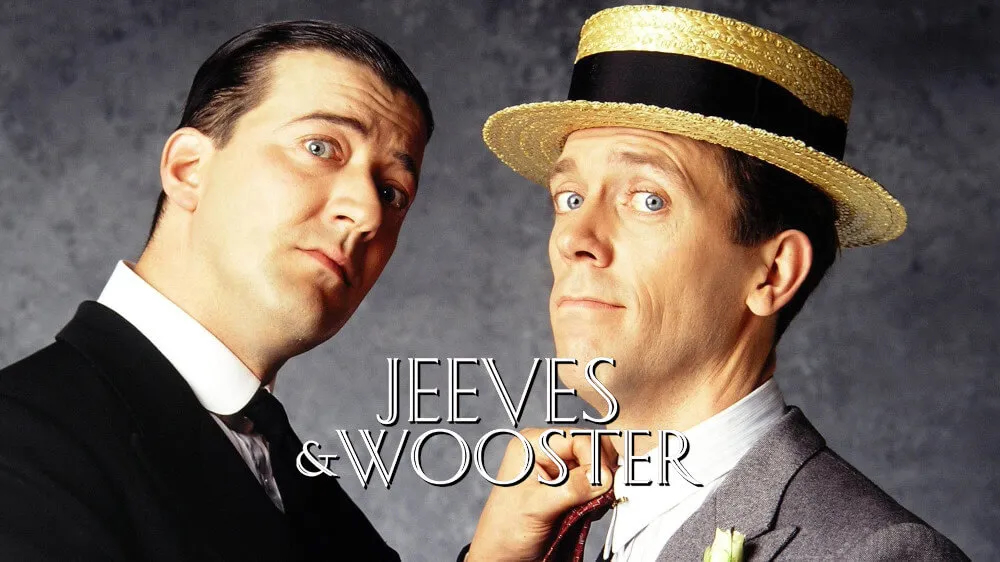
The lives of the upper class are an endless source of fascination, and when revealed by P.G. Wodehouse, they are subjected to satire ranging from gentle to devastating. Portrayed as entirely dependent on their valets and servants, the ‘gentleman’s gentleman’ is always supremely competent, no matter the chaos their ‘betters’ create. Skilfully adapted by Clive Exton to retain the style and feel of the original ‘Jeeves’ stories, the comedy duo Stephen Fry and Hugh Laurieknew they had to take the parts when they were offered to them. Their comedy skills proved perfect for the buffoonery of the characters.
Key Facts:
- Based on the ‘Jeeves’ stories written by P.G. Wodehouse
- Satirized the lives of the ‘idle rich’
- 23 episodes in four seasons from 1990 to 1993
- Jeeves and Bertie were played by Stephen Fry and Hugh Laurie
- Filmed at several real stately homes
Attitudes towards the British upper class have often revolved around a fundamental contradiction. How can someone competent to control the lives of millions be unable to change a lightbulb? This joke could be, as Freud said, a way of letting out feelings that deference to society prohibits. Or, as the upper class would reply, a failure to accept an appropriate hierarchy of abilities. Practical affairs are simply not important, and anyway, doesn’t everyone have a ‘gentleman’s gentleman’ to handle life’s problems with tact and skill? Bertram Wilberforce Wooster certainly did, in the shape of his valet – Reginald Jeeves. Today more likely to be described as a ‘personal assistant’, a suitable valet was considered essential to a smooth life, free of the petty tribulations that daily consume the energy of lesser mortals.
In 23 fifty-minute episodes over four seasons, aired originally between 1990 and 1993, the comedy team ‘Fry and Laurie’ gave life to these archetypal characters, in the show Jeeves and Wooster. They found humor in the incompetence of the upper class, and soothingly reinforced the belief that they only survive because of the quiet skills of their servants – ‘us.’ The characters were already well known, the creation of the writer P.G. Wodehouse. He became a successful author in large part by satirizing and poking fun at the arcane class system and the juvenile antics of the idle rich. Brought up himself by an English Nanny, educated at a top ‘public’ school (Dulwich College), he knew what he was talking about when he held up his fellows to the harsh light of comedy, satirizing their need for a skilled handler to prevent them making too much of a mess of their pampered lives. Wodehouse divided his life between America and the UK, writing Broadway shows, novels, short stories, and film scripts. But he is today mostly remembered for the 18 novels and short stories he wrote about Jeeves and Wooster.
The actors Hugh Laurie, who played Bertie Wooster, and Stephen Fry, who played Jeeves, were already well-known as comedians, and Laurie had been enamored of the ‘Jeeves’ stories since he was thirteen. When they were approached by the show’s producers, Carnival Films and Granada Television (ITV), they at first dismissed the idea of turning Wodehouse into television. Realizing that the show would be made with or without them, they relented, and Laurie recounted later how honored he felt to have the opportunity to embody his literary hero. Their well-honed comedy timing became a central element in the success of the show.
Much of the strength of the show comes from its fidelity to the original stories, which form the basis for most of the episodes. The script writer Clive Exton has already proven his ability with his adaptions of Agatha Christie’s Poirotseries, and Wodehouse was in safe hands. While Exton stayed true to the spirit of Wodehouse, he did not simply copy the stories. Instead, he wove his scripts out of two or three originals at a time, creating new stories that were perfect for the already-skilled double act of ‘Fry and Laurie.’
Many of the stories center on Wooster’s attempts to hold on to his confirmed bachelor status against the attempts of his Aunt Agatha, Lady Worplesdon. Often called his ‘fearsome aunt,’ Agatha was played by the well-known Mary Wimbush in the first three series, before she was replaced by Elizabeth Spriggs in season 4. It is always Jeeves who comes to Bertie’s rescue, finding ways to thwart Aunt Agatha’s matchmaking. The character of the relentless Agatha is in sharp contrast to that of her benign, sister, Aunt Dahlia, who is greatly loved by Bertie. She owns the weekly newspaper Milady’s Boudoir, a spoof on the very real The Lady, in print since 1885, and the only place to find suitable servants and staff.
Other recurring characters include Madeline Bassett, daughter of Sir Watkyn Bassett, and Bertie’s on-and-off fiancée. Played by several actors over the years, she is the British upper-class equivalent of the ‘dumb blond’. Sentimental, a reader of Winnie-the-Pooh, and seeking love, she is also sometimes engaged to Augustus Fink-Nottle (‘Gussie’), Bertie’s newt-loving friend. Gussie today might be compared to Jacob Rees-Mogg, MP. He was played by Richard Garnett in the first two seasons and then by Richard Braine. Bertie has another regular friend, Hildebrand Glossop (‘Tuppy’), played by Robert Daws, and they all spend time at the Drones Club, an aptly titled parody of the numerous private clubs in London. The Drones Club is set on the very real Dover Street, in Mayfair, where many of these clubs can be found.
Like all respectable members of the upper class, Bertie has access to numerous country homes, staying perhaps at Twing Hall or Brinkley Court, taking the sea air at Westcombe-on-Sea, or staying in a cottage in Chufnell Regis. He is even, in one episode, forced to appear among the youth of the middle class after he is persuaded to hand out the prizes at Market Snodsbury Grammar School. Lovers of English place names will recognize potential real-life equivalents for all these fictional locations, perhaps only matched by Dicken’s for their cleverness.
The Jeeves and Wooster stories are set in a timeless world that is based on the period between the two world wars, but nobody ages and real-world events are rarely mentioned. This floating timeline device suspends the action in an idealized version of history, creating an unreal, nostalgic past that is a large part of the appeal of England to visitors and overseas fans. Viewers can safely escape into this fantasy world, enjoying its connection to real places and recognizable archetypes of the English character.
Music plays a large part in the show, from the theme tune created by the Oscar-winning composer Anne Dudley, to the musical interludes, where Bertie and Jeeves perform popular numbers from the 1920s and 30s. Dudley’s theme music was written in the Swing music style, and she cleverly re-uses it throughout the show, in different moods, as the background score. The musical performances by Bertie can only be described as ‘tortured’, but with the confidence bred into his class, he is convinced of their splendor.
Cultural Impact
Jeeves and Wooster continues to be popular, partly for the quality of its production and acting, and partly for the continuing fascination with the lives of the British upper class, particularly in North America.
Awards:
- Eileen Diss, British Academy Television Award for Best Design, Series 3
- Derek W. Hayes, British Academy Television Award for Best Graphics, series 4
- Dany Everett, a British Academy Television Award for Best Costume Design
- Anne Dudley, British Academy Television Award for Best Original Television Music
Nominations:
- British Academy Television Award for Best Drama Series
Places to Visit
Berkeley Mansions, Bertie’s London flat, is in Mayfair, but the exteriors were performed by 2 Mansfield Street, Marylebone.
Totleigh Towers, home of Madeline Bassett, is played by Highclere Castle, Highclere, Hampshire. It is open for visitors on select dates in the spring and summer. It is the home of the Earl of Carnarvon, and the grounds were landscaped by Capability Brown.
Brinkley Court, home of Aunt Dahlia, is played for its interior scenes by Wrotham Park, Barnet, Hertfordshire. In the Palladian style, the house dates from the 18th century. It is not open to visitors, but it can be booked for private events, including wedding receptions and parties.
Exteriors for the early series were filmed at Barnsley Park, Barnsley, Gloucestershire. Set in the beautiful Cotswolds, there are several cottages on the estate that can be rented for short visits. For season 4, Brinkley Court exteriors were filmed at Hall Barn, Beaconsfield, Buckinghamshire. That house has been used extensively for film and TV productions, including Downton Abbey and Chariots of Fire. The house dates from the 17th century, but it has been extensively remodeled since then. The house and grounds are not normally open to visitors.
Westcombe-on-Sea, the fictional seaside town, was filmed in Sidmouth, Devon, at the ‘Victoria Hotel’ and the ‘Hotel Riviera’.
Chuffnell Regis, the village where Bertie stayed, was filmed in Clovelly, Devon.
Several National Trust properties across England have well-preserved servant’s quarters, which give a taste of the real life of Jeeves and his fellow workers. Berrington Hall, Herefordshire, is notable for these features, as also are Lanhydrock and Castle Drogo, both in Devon.
Where to Watch
- All four seasons can be found individually, and in collections, on DVD
- It is not currently streaming anywhere (which is a real shame!)
- The music of the show can be purchased on CD or on Apple Music

