
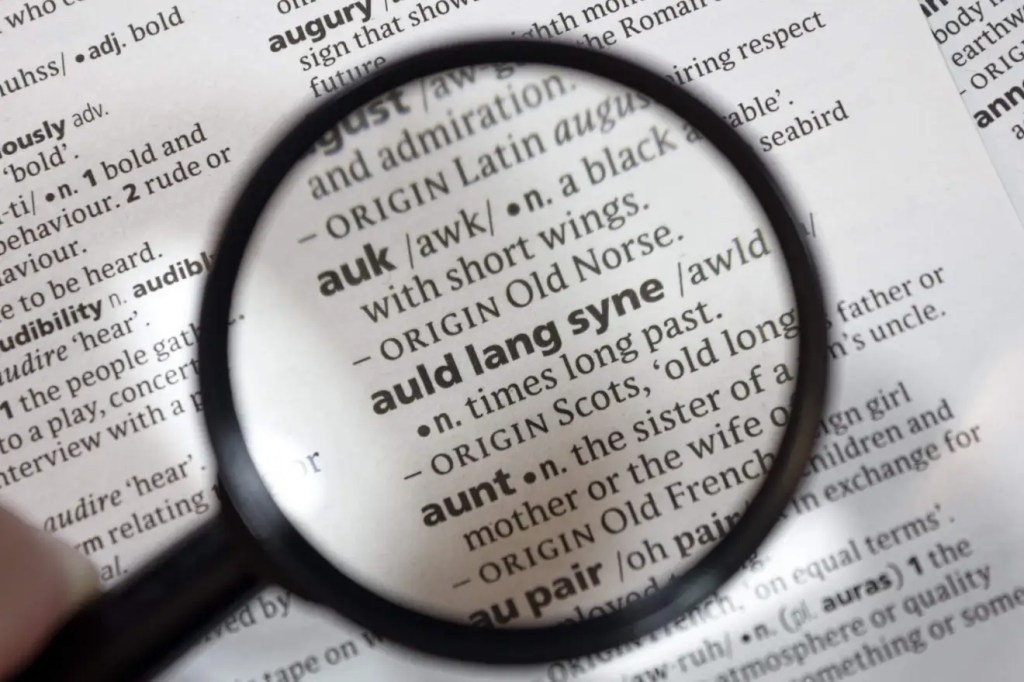
When the clock strikes midnight on New Year’s Eve, we partake in a number of traditions. You may pop the cork on a champagne bottle, light up some fireworks, kiss your sweetheart, or engage in an age-old chorus of Auld Lang Syne. Most people don’t know what the title means, but it’s become part of our New Year’s rituals since the lyrics were first put to music in 1799. Interestingly, most people may not know that the song predates even that, when it was just a poem by one of Scotland’s greatest writers, Robert Burns. Read on to know more about the fascinating history of this song and we’re sure you’ll be hearing it play in your head before you’re done.
Robert Burns sent the original lyrics to the Scots Musical Museum in 1788, claiming it was an older Scottish folk song that he had transcribed from an older man. A version of the lyrics had been put to print back in 1711 by James Watson, but differed from Burns’s version in several ways and was called “Old Lang Syne”, though it’s clear both versions of the song had a common origin. Burns’s version of Auld Lang Syne didn’t appear in print in the Scots Musical Museum until 1796, after he had passed away. The title, in Scots, translates to English as “Old Long Since” and means “days gone by.” The lyrics, as you might be able to figure out, focus on remembering old times.
The tune, as we know it, came from a different location altogether. The melody that would eventually be paired with the poem came from the opera Rosalina by English composer William Shield. The comic opera was first performed in 1782, and the tune would appear by itself in 1792, also in James Johnson’s Scots Musical Museum. It wouldn’t be until 1799 that lyrics and music were put together for the first time as part of George Johnson’s book, Select Songs of Scotland. Over the next century, the song was reprinted numerous times and became an annual part of the Hogmanay holiday, the Scottish celebration of New Year’s Eve.
It’s tradition for Hogmanay celebrants to hold hands in a circle just before midnight and begin singing the song as the clock strikes midnight. At the beginning of the final verse, the singers cross their arms above their bodies so that their left hand is holding the right hand of the person next to them. At the end of the song, everyone rushes to the middle in an embrace. Outside of Scotland, many people cross hands at the beginning of the song rather than on the final verse. At the Millennium Dome celebrations in 2000, Queen Elizabeth II performed the act in the traditional Scottish way and was criticized by the English press for not performing it correctly at the beginning.
Auld Lang Syne made its way to North America courtesy of Canadian band leader Guy Lombardo. Lombardo and his band, the Royal Canadians, began performing the song for a series of radio (and later television) broadcasts starting on December 31, 1929. The Royal Canadians performed the song for roughly five decades until 1977, popularizing Auld Lang Syne not just in Canada but the United States as well. In fact, it’s the Royal Canadians’ version of the song that plays when the ball drops in New York City’s Times Square. The song can also be sung outside of New Year’s Eve to celebrate a farewell, a graduation, a funeral, an outgoing government, or any similar situation that could be considered a parting or a change from one chapter of life to the next.
 London visitor