
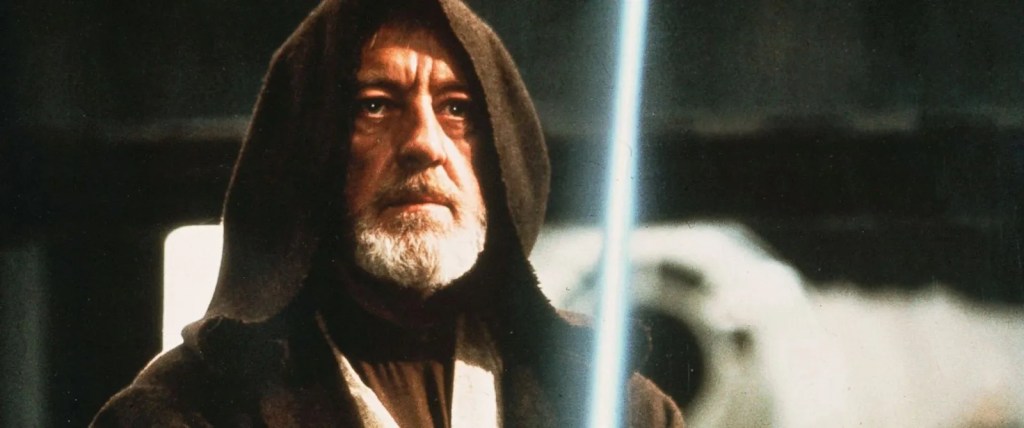
Con Man, Spymaster, and Jedi Sir Alec Guinness took on many unforgettable roles over his career as an actor. Guinness made a name for himself early in his acting career by starring in several Ealing Studios comedy films and showed what a dramatic powerhouse he could be in 1956’s The Bridge Over the River Kwai. Younger audiences, of course, mostly know him as Jedi Master Obi-Wan Kenobi in the Star Wars films before Ewan McGregor took over the role at the turn of the 21st Century. Naturally, such a long and storied career lends itself to a number of great facts about one of Britain’s best actors.
Single Parent Household
Sir Alec was born Alec Guinness de Cuffe in 1914, though his birth certificate did not list a father. At the time, that portion could only be filled out if the father was present and gave his consent per an 1875 law concerning illegitimate children. Since Alec’s father did not sign, we don’t know who he was and he was not a presence in his son’s life. Guinness himself believed that his father was a Scottish banker named Andrew Geddes, who would often visit the family posing as an “uncle” and paid for Alec’s education.
Alec, the Fanboy
The actor was apparently a huge fan of the show Due South, a “dramedy” series about a Mountie and a Chicago cop solving crimes.
And the Award Goes to….
Alec Guinness was no stranger to the Academy Awards. He was nominated for Best Actor for The Lavender Hill Mob but ended up winning the award for playing Colonel Nicholson in Bridge Over the River Kwai in 1957. In 1958, he was nominated in the category we know today as Best Adapted Screenplay for The Horse’s Mouth. He was also nominated for Best Supporting Actor for Star Wars: A New Hope and Little Dorrit. To date, he’s the only actor from the Star Wars franchise to be nominated for their role in the movies.
Thanks, but No Thanks
When he found out that he was going to win a Lifetime Achievement Oscar, he wasn’t terribly thrilled about it and refused to attend. The Academy sent out Dustin Hoff to talk him into going, and Hoffman’s similar attitude toward acting convinced him to go to the ceremony.
Need a Place to Stay?
Harrison Ford once said that Guinness helped him find an apartment during the filming of Star Wars: A New Hope.
Studying the Footage
To prepare for his role as Obi-Wan Kenobi in the prequels, Ewan McGregor not only watched the original trilogy (of which he was already familiar through his uncle Dennis “Wedge Antilles” Lawson) but also many of his other early roles to get his speech pattern and mannerisms. McGregor wasn’t the only one who took their cues from Guinness, as Watto’s voice actor, Andy Secombe, based his character’s voice on Guinness’s portrayal of Fagin in the 1948 adaptation of Oliver Twist.
Quite the Contrast
Guinness played a seasick Royal Navy officer in the Ealing Studios comedy All at Sea, but in reality, he served with distinction in the Royal Navy during WWII and commanded landing craft that invaded Sicily and Elba.
Don’t Call Me “Sir”
Alec Guinness was awarded his CBE in 1955, knighted in 1959, and made a Companion of Honor in 1994 by Queen Elizabeth II for his services to drama. Despite all that, he didn’t care to be referred to as “Sir Alec Guinness.”
Not the Biggest Fan
While the conventional belief is that Alec Guinness hated being remembered as Obi-Wan Kenobi, his main concern was that younger audiences only knew him for Star Wars rather than the wealth of roles he had portrayed prior to the Star Wars films. Guinness was allegedly approached by a young fan in 1980 who said he’d seen the movie 100 times and, horrified, Guinness told him he’d give him an autograph if he never watched it again. Carrie Fisher once said that Guinness paid Mark Hamill £20 to leave him alone because Hamill would constantly badger him with questions about his career or acting advice. However, in his autobiography, Guinness recounted that Star Wars let him “live for the rest of my life in the reasonably modest way I am now used to, that I have no debts, and I can afford to refuse work that doesn’t appeal to me.”
And Also With You
In one of those great misquotes owed to the Mandela Effect, Guinness’s well-known line “May the Force be with you” was actually “The Force will be with you, always.”
 London visitor