
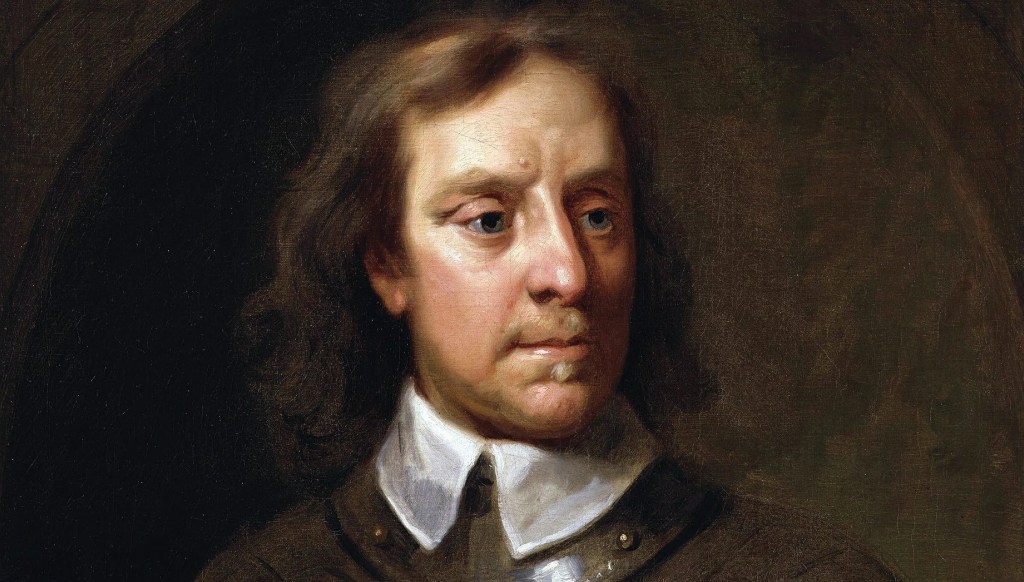
Around this time of year, stories and rumors float around on the internet about bans on Christmas, but there’s really only one time in history that the holiday was effectively canceled by a governmental authority. Some believe that Oliver Cromwell personally canceled Christmas during the Commonwealth period, but that’s not the whole of it. The banning of Christmas actually began with Puritan leaders in England long before reaching the halls of Parliament, where legislation nearly killed the holiday for good. Have a look at the circumstances that gave rise to the Puritans’ war on Christmas, how the ban manifested, and the holiday’s slow recovery.
The period of the English Civil War and the ultimate Parliamentarian victory in 1645 coincided with a growing Puritan religious movement, both of which transformed Britain’s government and culture. For decades prior, more orthodox Protestant leaders in England had preached against the celebration of holidays as doing so felt too close to Catholic ceremony as well as the potential for sin that came with making merry. As Puritan influence grew in Parliament, the first attempt at limiting Christmas celebrations came in 1643 when Parliament issued a statute that stated Christmas was meant to be a day of solemn fasting and penance. However, the decree from Parliament was widely disregarded.
The next year was a different story. Whereas King Charles I had largely allowed and promoted the celebrating of holidays, Cromwell was of the mind to clamp down on Parliament’s Act banning the holiday’s celebration, partially under his mistaken belief that Charles was a secret Papist. The 1644 ordinance reinforced the previous year’s ban and added the holidays of Easter and Whitsun (also known as Pentecost). The public did not take well to the edict, and many businesses closed in protest on Christmas Day while some that remained open in keeping with the law were attacked. Throughout England, pro-Christmas riots often resorted in violence and calls for the Restoration of the monarchy.
By the time that King Charles I was executed in 1649, enforcement of the ban was much harsher. By 1652, Parliament decreed that December 25th should not be marked by any special religious services, and soldiers stripped churches of their Christmas decorations. In 1656, armed soldiers were patrolling the streets of London, seizing food being prepared for the holiday. In 1657, a congregation was arrested in Exeter Chapel for observing the sacrament on Christmas Day. Such draconian enforcement of the law remained in place until the Restoration in 1660, when King Charles II was established as the Sovereign.
Christmas was back, but wasn’t quite the same. In the wake of the Puritan assault on the holiday, celebrations were much more subdued, and increasing urbanization saw festive celebrations move away from the city and into the countryside. Christmas as we know it today would not begin until the Victorian Period. It was during this time that Prince Albert helped popularize the German tradition of a Christmas tree (something originally begun with the Hanoverian Dynasty). Additionally, Charles Dickens’s publication of A Christmas Carol helped bring the holiday back to England’s cities as well as popularizing many Christmas traditions, including the saying of “Merry Christmas.” Dickens’s work helped to emphasize a charitable take on the holiday as well as revitalizing family gatherings, holiday meals, and fun.
So, as you sit down with your family to have Christmas dinner, sing carols, worship, and give each other gifts, remember there was a time when such traditions were not possible. It came from a group that forced a strict observance of its own orthodox views on the remainder of the country and was roundly resisted by those who felt that love for their fellow humans should be celebrated at the birth of Christ.
 London visitor