
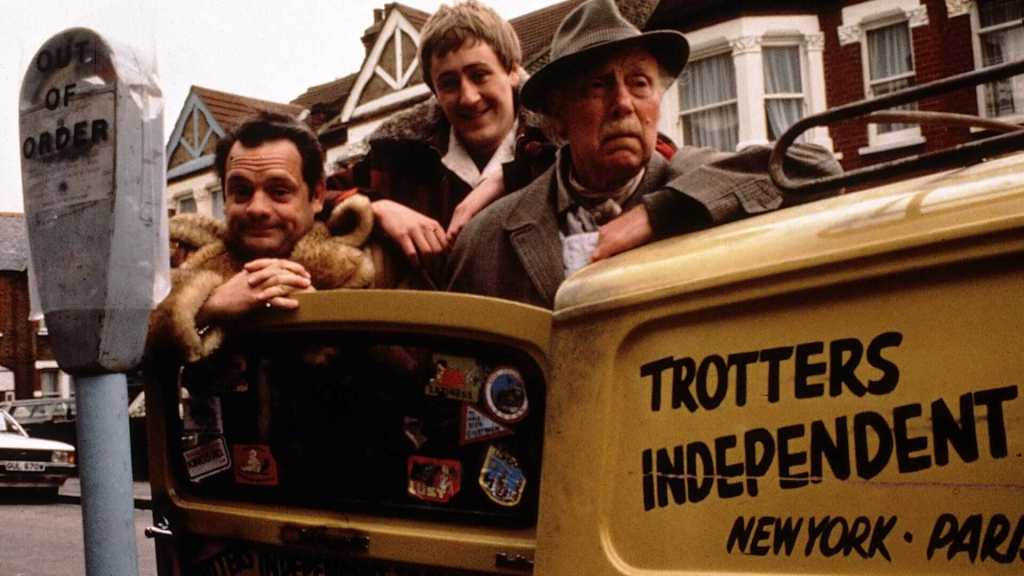
‘Only fools and horses work for a living’ was the obscure expression the working-class writer John Sullivan chose for the title. His sitcom follows the ups and downs of an illegal street trader, Del Boy, his younger brother, and Grandad, as they attempt to escape from both poverty and class, a hopeless task on both counts, although, in the end, wealth proves easier to achieve than entry in the higher classes of English society. Del’s many ‘get rich quick’ schemes provide endless comic opportunities, and Sullivan’s finely observed characters grow and evolve as the seasons flow by, with the ups and downs of real life, seen through a satirical and comic lens.
Key Facts:
- Six seasons shown, between 1981 and 1999, plus specials
- Starred David Jason as Derek’ Del Boy’ Trotter, Nicholas Lyndhurst as Rodney Trotter, and Lennard Pierce as Grandad
- Voted Britain’s Best Sitcom in 2004
- Written by John Sullivan, who grew up in working-class Balham
- Developed a strong cult following and contributed to English slang
A Short History
Although locked into a complex class structure, the British are still able to laugh equally at the foibles of all its social groups. Shows like ‘Steptoe & Son’ and ‘Till Death us do Part’ in the 1960s aimed at the working class, while the later ‘Spitting Image’ skewered Royalty with a sharp spear. The foibles of the working class, though, have always been a rich source for comedy writers, and the appeal of the social faux pas for comic effect is always tempting. The bustling street markets of London, and the eccentricities of the street trader, were the inspiration for Only Fools and Horses, a TV comedy series that ran throughout the 1980s and that was voted ‘Britain’s Best Sitcom’ in 2004.
Only Fools and Horses follows the daily life of market trader Derek ‘Del Boy’ Trotter, his younger brother Rodney, and their Grandad, as they struggle to find the wealth to escape their life in Peckham, a working-class neighborhood of south-east London. They live in a council flat (state-provided and owned apartment) in Nelson Mandala House, a grim high-rise apartment building, and ever since their mother died when the boys were young, and their father left shortly afterward, Derek has been the family head and provider, surviving by buying and selling odd items that may have ‘fallen off the back of a truck’ or have come his way under other doubtful circumstances. His goal is to become a millionaire with some dubious scheme or other, and these plans – always unsuccessful – form the basis of the plots, which usually occupy a single episode. Only later in the series did longer story arcs begin, and a broader picture of their lives and surrounding society emerged. By the end of the series, a viewer has gained a rich picture of the backstories of the characters, and this ‘epic novel’ character of the show is a secondary strength to its immediate comedy.
The accuracy of the characters is guaranteed since the writer, John Sullivan, grew up in Balham, another south London working-class area. His father was a plumber, and he remembers always being fascinated by the bottom end of the street market scene and particularly the men variously called: ‘spivs’; ‘fly traders’ (because they traded ‘on the fly’ to dodge the authorities); or, later, ‘readies’ (ready for anything). Often selling out of suitcases they opened on the street, these characters were Sullivan’s inspiration for Derek Trotter. Sullivan had left school unqualified and eked out a living as a young man in a variety of unskilled jobs, from messenger boy to window cleaner and carpet layer. He persisted in submitting scripts to the BBC, finding his first success with Citizen Smith, and then being commissioned to create Only Fools and Horses.
The show was first aired on the 8th of September 1981, and the first season ran for six episodes, each of 30 minutes. Further seasons, usually also of 6 episodes, ran in 1982, 1983, 1985, 1986, 1989, and 1990. In addition, almost every year, there was a Christmas Special episode, and in 1996 three one-hour episodes ran as a Christmas Trilogy. Each Christmas Day of 2001, 2002, and 2003, additional 75 minutes specials were shown. As well, there were a variety of sketches, promotional pieces, and other shorts created between 1992 and 2015.
The story arc follows ‘Del Boy’ (played by David Jason) in his cheap gold jewelry and camel coat as he strives to become rich, eventually achieving that and then losing most of it again. His business, Trotters Independent Traders (T.I.T.), operates out of a suitcase or from the back of his yellow three-wheel van. By the end of the series, he has begun to emulate the richer ‘yuppies’ who are gentrifying his neighborhood. After a succession of failed relationships, he eventually meets his ‘significant other’ in a late episode. Rodney typifies the working-class man who struggles to present himself as ‘classier’ – an effort always doomed to failure in a society with an acute ear for the subtle cues of class. He affects knowledge he lacks, in particular by attempting to use basic French, but always wrongly. When on holiday in Spain (a stereotypical working-class destination), he takes a ‘fiesta’ after lunch. Much of the humor in the series lies in the knowing way an English person will see through these ultimately pathetic attempts to be what he is not.
Rodney (played by Nicholas Lyndhurst) struggles to free himself from Derek’s control, and looks scornfully at the shady ways Derek tries to become rich. Rodney did well in school but was expelled from Art College for smoking cannabis, and now struggles to become independent. He finds himself a middle-class girlfriend, Cassandra (played by Gwyneth Strong), who lives on the fashionable King’s Road. Even though he lies about his background, she takes to him, and their relationship and marriage continue through the later seasons.
The foil to the younger generations is Grandad (played by Lennard Pierce), who is a stereotypical infirm ‘OAP’ – old age pensioner – who watches TV all day and is generally abused and derided by his grandchildren. When Pierce died in 1984 Grandad was buried, and his place taken by Uncle Albert (played by Buster Merryfield), who can always be relied upon for a story that begins, “During the war. . .” When Merryfield died in 1999, his character also died, and his ashes were scattered in the English Channel.
By the sixth series the writer wanted Del Boy to give up chasing younger girls and settled down, so he created Racquel (played by Tessa Peake-Jones), a woman Del meets through a dating agency. Kind-hearted like Del, but also a failure, she has tried to be an actress but more often works as a stripagram. By the end of the series, they are still not married, although Del seems interested in settling down.
Minor characters in the series include Trigger (Roger Lloyd-Pack and Lewis Osborne), who is a street sweeper and not too bright. He is a regular at the local pub, the Nags Head, and his father, “Died a few years before he was born.” Boycie (John Challis) is a successful used-car salesman, and the richest man at the Nag’s Head, while Denzil (Paul Barber) is a long-distance lorry driver and regular victim of Del’s get-rich schemes. The crooked policeman, DCI Slater (Jim Broadbent), only appears in three episodes, but is a regular presence in the background of the series.
Cultural Impact
Initial viewing figures for the show were well below 10 million, but by the end of the third series, that barrier had been broken, and it eventually peaked at 24.3 million for the third episode of the 1996 Christmas trilogy – over 40% of the national population at the time. After it was voted Britain’s Best Sitcom in 2004, several ‘Story of. . .’ documentaries were produced. Two spin-off series, The Green, Green Grass and Rock & Chips were produced in the early 21st century, and a stage-play version was launched in February 2019 at the Theatre Royal Haymarket, London. Two board games based on the show were also created. The show has also won numerous popularity awards, and it ranks high in polls of the greatest TV shows ever.
The show has been viewed internationally, with particular interest in the countries of the former Yugoslavia, where the show is called Mućke, meaning ‘shady deals.’ It was remade in The Netherlands as Wat schuift’t? (What’s it worth?), and in Portugal and Slovenia. Several attempts to launch a US remake have been made, only to be rejected in their final stages.
The ‘Only Fools and Horses Appreciation Society’ was launched in 1993, with around 7,000 members. It releases a quarterly newsletter, and it has annual conventions of fans and cast members. It also stages Shows featuring props from the show, such as the yellow van.
Several of the tag lines from the series have entered everyday speech in England, such as ‘Plonker’ (a fool or idiot), ‘Cushty’ (good, delightful), and ‘Lovely jubbly.’ The show has reinforced cultural stereotypes of working-class people and habits, as well as disarming them by turning those elements into comedy memes.
Places to Visit
- London still has many street markets, but most have been gentrified in various ways, and may give only a limited picture of the flavor of traditional markets.
- Deptford Market is near ‘Del territory,’ and this basic market of food and cheap goods runs from 7 am to 4 pm, Wednesday, Friday, and Saturday, on Deptford High Street.
- Brick Lane Market is held on Sundays from 9 am to 5 pm, and it has a range of goods. This traditional east-end market has gone upscale to a degree, and today incorporates the nearby Truman Market.
- Petticoat Lane Market operates every weekday, and Sunday mornings. It is primarily a clothing market, with much of the old atmosphere. It is situated in Spitalfields, near Aldgate Tube Station. A Sunday visit could include the nearby Columbia Road Flower Market.
- Although set in Peckham, most of the show, and all the later series, were filmed in Bristol. Several small companies offer tours of outdoor locations.
- Tower blocks in the UK have gone from being desirable council housing when first built in the 1950s, to scenes of social decay, and back to desirable housing again, today in private hands. Towers such as Trellick Tower (Kensal Town), Keeling House (Bethnal Green), Sivill House (Shoreditch) and The Barbican Estate (City of London) are admired and desirable homes for young professionals in particular. Many are iconic, listed buildings, and examples of British brutalist architecture. A visit is a reminder that there is more to Britain than ancient buildings and museums.
Where to Watch
- Complete collections of all the series of ‘Only Fools and Horses’ are available on DVD.
- Netflix is currently not steaming the series, but it is available on Britbox.
- All episodes of the show are available for download purchase on iTunes.
Further Research
- “The Only Fools and Horses Story, by Steve Clark, 1996
- “The Complete A-Z of Only Fools and Horses, by Richard Weber, 2003
- The Bible of Peckham. a three-volume edition of all the scripts, 2017
- He Who Dares…, by Jim Sullivan, a fictional autobiography of Derek Trotter, 2015
- You Know It Makes Sense, Lessons from The Derek Trotter School of Business (And Life), by Jim Sullivan, 2018
- The People: The Rise and Fall of the Working Class, 1910-2010, by Selina Todd
- The Myth of Meritocracy: Why Working-Class Kids Still Get Working-Class Jobs, by James Bloodworth
 London visitor