
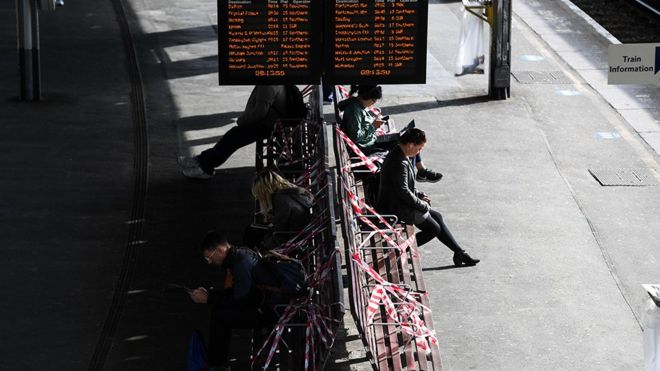
During lockdown there have been reduced services on trains and buses but with restrictions being eased and more people being encouraged to return to work passenger demand is expected to increase.
From Monday 15 June, anyone travelling on public transport in England should wear a face covering — to help reduce the risk of spreading coronavirus.
The government has advised people to walk, cycle or drive but if that’s not possible what are the risks of getting Covid-19 on public transport?
How safe are trains and buses?
A lot of the potential risk of infection on trains and buses depends on how crowded they are, and so how far away you can keep from other people. This applies both on the vehicles and at stops and stations, and will vary in different parts of the country and on different routes.
Ventilation also plays an important role as fresh air can help droplets containing the virus dissipate faster, so being able to open a window can be an advantage.
Coronavirus spreads when an infected person coughs, sneezes or exhales small droplets packed with the virus into the air.
These droplets can enter the body through the eyes, nose and mouth, either directly or after touching a contaminated object.
The government’s consistent message has been to stay 2m (more than 6ft) apart from people outside your household.
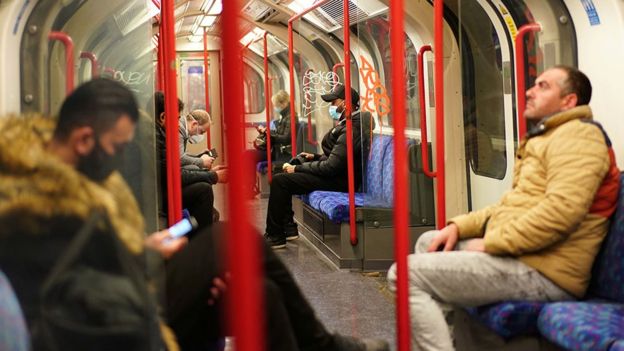
Previous research has suggested a link between commuting on the London Underground and the likelihood of catching respiratory illnesses.
Dr Lara Gosce, at the Institute of Global Health, says her research (published in 2018) showed people who used the Underground regularly were more likely to suffer flu-like symptoms.
«Particularly, it shows that boroughs served by fewer lines — where inhabitants are forced to change line one or more times when travelling on the Underground — have higher rates of influenza-like diseases, compared to well-served boroughs where passengers reach their destination by one direct trip,» she said.
If you’re travelling on a relatively empty train or bus, though, your risks would be different. How long you spend on transport will also play a role — spending more time in contact, and coming into contact with more people will increase your risk.
So, «limiting the number of close contacts with potentially infected individuals and objects is important,» according to Dr Gosce.
«In terms of travel, avoid peak hours if possible,» she says, suggesting, where viable, passengers should choose routes involving only one means of transport.
What is the advice for passengers?
The government says people should «consider all other forms of transport before using public transport». If they can’t walk, cycle or drive to their destination, they are advised to:
- Travel at off-peak times
- Take a less busy route and reduce the number of changes
- Wait for other passengers to get off before boarding
- Keep 2m away from people «where possible»
- Wash their hands for at least 20 seconds after completing their journey
The government acknowledges that there may be situations where people can’t keep 2m away from each other, such as at busy times or getting on or off public transport. In these cases, the advice is to avoid physical contact and face away from others.
Face coverings will be compulsory for people on public transport in England from 15 June (children under 11, disabled people and those with breathing difficulties will be exempt).
Governments in Scotland, Wales and Northern Ireland are asking people to wear them on public transport but are not making their use mandatory.
Face coverings can help reduce the risk of transmission in some circumstances. In particular, they are to stop the wearer passing on coronavirus, rather than protecting them from others.
What safety measures are travel operators taking?
Transport companies have been enhancing their safety measures to protect staff and passengers.
Transport for London (TfL) says from Monday, customers should wear face coverings at stations and for their entire journeys.
It has distributed 30,000 of these and will use it enforcement officers, along with officers from the Metropolitan Police and British Transport Police to help customers «comply with the new requirement».
TfL has installed hand sanitisers at all tube, rail and bus stations and has also introduced a rigorous cleaning schedule.
Network Rail, which owns Britain’s rail infrastructure, introduced a new timetable on Monday 18 May, which added about 3,000 trains per day. But the company said passenger capacity was still only between 10% and 13% of normal levels.
It says it has been carrying out «deep cleans» and making changes in stations so people can maintain social distancing.
 London visitor