
It’s a design classic, but in these days of ubiquitous mobile phones, only 10,000 of the red kiosks remain on the streets. Can they survive the next decade?
John Farmer, who describes himself as an activist shareholder, is a man with a mission – to save Britain’s red phone boxes. These were once a feature of every high street in the country, but now number only 10,000 or so (and half of those are decorative rather than operational). At the recent annual general meeting of British Telecom, which even in the age of the mobile phone has a statutory obligation to maintain a payphone network, Farmer demanded that more be done to maintain the traditional red boxes. It was a point he has made at past AGMs – always, he says, to audience applause.
In 2015 the traditional red phone box was voted the greatest British design of all time, ahead of the Routemaster bus, the Spitfire, the union jack and Concorde. It was designed in 1924 by the architect Sir Giles Gilbert Scott, whose other creations include Liverpool’s Anglican cathedral and Battersea and Bankside power stations. Many believe Scott’s design echoes the tomb that the architect Sir John Soane built for his wife in 1815.
In his book he lauds Scott’s original design, designated Kiosk No 2 (usually abbreviated to K2) by the General Post Office, which was then responsible for the phone network. “The Kiosk No 2 was a miniature building,” he writes. Scott’s K2 design, easily identified by its small, square windows, was superseded in 1936 by his K6, which was smaller and had larger, horizontal windows to let more light into the box. The K2 had never caught on outside London because it was expensive, but the cheaper K6 was adopted nationally and by the late 1960s, when the utilitarian K8 was introduced, designed by the architect Bruce Martin, there were more than 70,000 in use across the country.
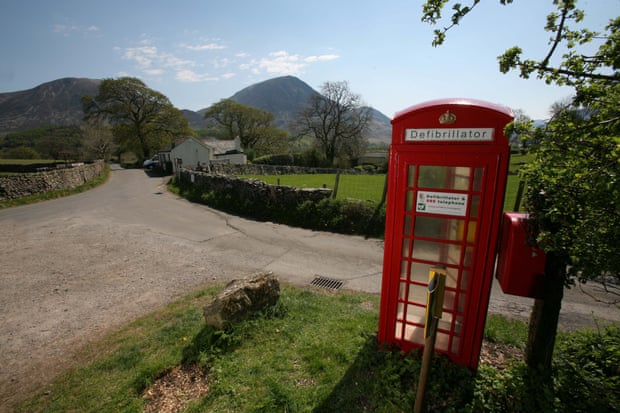
There are still numerous Scott kiosks in central London, many of which have been listed as historically or architecturally significant – a response to the destruction of many boxes by the newly formed British Telecom in the 1980s. Remarkably Scott’s original wooden prototype still stands outside the Royal Academy in Piccadilly. Across the UK, more than 3,000 kiosks have been listed, including all the K2s, so there is no danger of them disappearing from Britain’s streets. Neil Scoresby, BT’s general manager for payphones, tells me a revolution in payphones is under way, reflecting the fact that only about 30,000 calls a day are now made from them. Over the next decade, most of the current 31,000 street kiosks (they are mostly ugly, post-Scott designs) will be swept away and replaced by three metre-tall InLink pillarsand other devices that combine free calls with wi-fi services and are funded by advertising, but about 2,500 red boxes will be retained and converted for digital use.
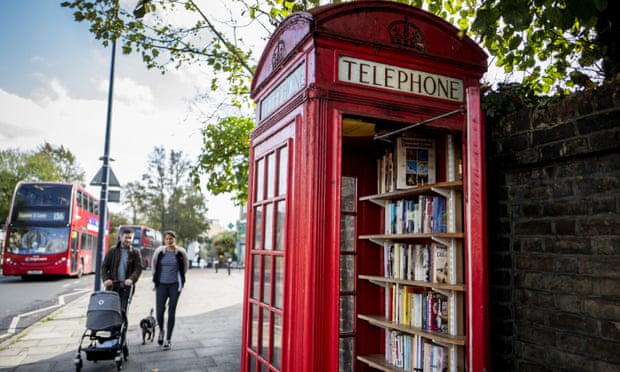
Other uses for the boxes are rich and varied. Book-swap points that double as miniature libraries are popular. The village of Marton cum Grafton in North Yorkshire was one of the pioneers, opening a mini-library in 2010; another was opened in the London borough of Lewisham in 2013. I visited the latter and was impressed by the range of books. Not just airport fodder, but novels by Orhan Pamuk and Henning Mankell, an ancient book of English poetry and the catalogue of the Mezipatra Queer film festival, with text in Czech and English.

The boxes are also useful for stunts. In 2011, residents in the Cambridgeshire village of Shepreth opened a pub (called the Dog and Bone, of course) in the local phone box to protest about the closure of their real local. The campaign seems to have paid off because that pub, the Plough, reopened in 2014. Incredibly, I can find no evidence of any plays being performed in a phonebox at the Edinburgh festival. Next year I plan to give my Hamlet in a kiosk on the Royal Mile. Though this be madness, yet there is method in it.
Individuals can also buy boxes that aren’t listed and have no prospective adopter, so are being removed. A box in poor condition will set you back almost £2,000 on eBay, or you can buy a refurbished K6 for £2,750 (plus VAT and delivery) through BT’s approved reseller X2Connect. Unicorn Restorations also supplies beautifully restored boxes – at eye-watering prices if you want a rare K2 – drawing on stock it accumulated in the 1980s and 90s when unwanted and unloved red boxes were plentiful.
“We supply boxes to private buyers and commercial organisations,” says a director of X2Connect, Martin White. “They go all round the world. We’ve done shopping malls in Florida and Dubai. They’re very popular in Australia and America, but places in Europe take them as well. People put them in their gardens and companies have them in their offices. They buy them as birthday presents or just for themselves, telling us it’s something they’ve always wanted.” White says that eventually the supply will dry up, but his company has enough to keep it going for a good few years yet.
The cult of the boxes is a strange and powerful one. The sculptor David Mach, who 30 years ago laid 12 of them end to end in the centre of Kingston upon Thames in a celebrated piece of public art called Out of Order, describes them as a “universal Great British thing”. “The design is fantastic,” he says, “and then it seeps wholesale into the ground and comes back up through the soles of your feet.” They have featured on a million postcards and, having been a central feature of British life for much of the 20th century, in many films. Tourists still go to the fishing village of Pennan in Aberdeenshire in search of the phone box that features prominently in the 1983 film Local Hero, not realising that the box used in the film was a wooden prop. Pennan does have a real box, with a less perfect view of the sea than in the film, so visitors make do with that.
Scott’s kiosks are loved in part because they are redolent of a time when the British were willing to build a small house from which anyone could make a call. They represent civic pride and national confidence – both now in short supply. Farmer is horrified at my suggestion that we should just let them go. Objects have a use, so why keep them when they lose that use? He finds such iconoclasm detestable. “We don’t want to become like the Americans,” he says. By which I presume he means a throwaway society. But equally the veneration of the past can go too far. We surround Battersea power station with anodyne, absurdly pricey flats and tell ourselves we have rescued it, even though it has lost all its stark beauty.
I wonder how Scott’s K2s and K6s will look 50 years from now, when everyone has forgotten why they were ever there and thinks they were built as micro-libraries and art galleries, coffee kiosks and collection points. Or in 1,000 years when, as with Stonehenge, our descendants will ascribe some deep religious significance to them. Which, given the way they are now worshipped, might not be far from the truth.
 London visitor